

New medical device regulations by Thailand’s Food and Drug Administration (Thai FDA) in 2021 introduced a more structured and transparent medical device registration process. Medical devices manufacturers need approval from the Thai FDA and a Local Authorized Representative (LAR).
Pure Global simplifies the process with AI workflows that accelerate TFDA submission preparation, along with local support and representation, all for a flat annual fee.

Thailand’s medical devices market will reach $2.29B by 2025 (6.22% CAGR), and the IVD market$1.63B by 2030 (6.3% CAGR). Growth is driven by rising healthcare spending (3.7% of GDP), an aging population (13.7% 65+ in 2021), and high medical device imports ($2.1B in 2023).
.png)
Medical devices sold in Thailand are regulated by the Medical Device Control Division (MDCD) within the Thai Food and Drug Administration (Thai FDA). Current medical device regulations in Thailand include:
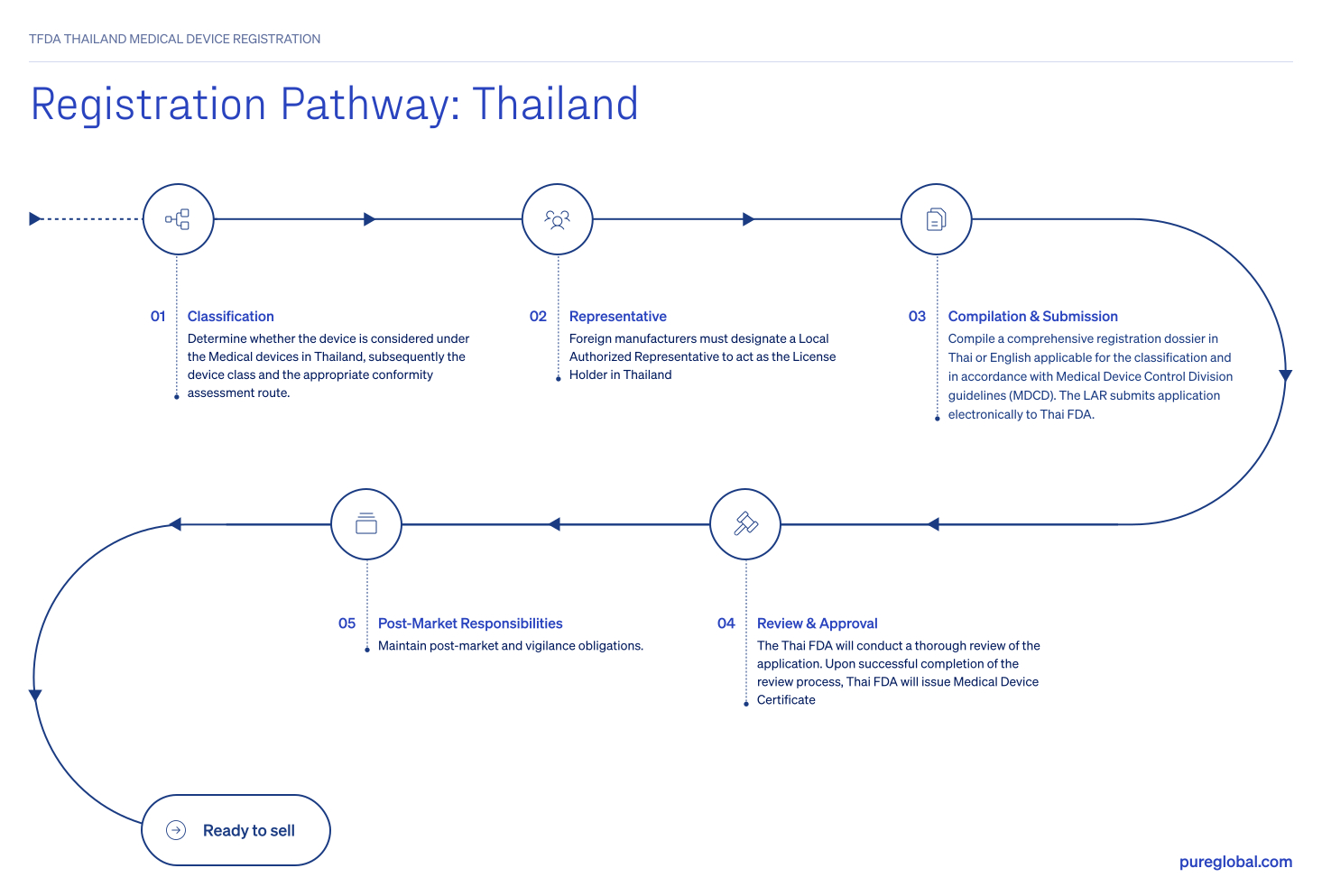
Any company that manufactures or imports medical devices for sale in Thailand must first obtain the appropriate license to produce or import their devices. Foreign manufacturers must also appoint a local authorized representative (LAR) to hold the license and act as the importer.
Thailand classifies devices and IVDs into four risk-based classes: Class 1, 2, 3, and 4. The classification determines the regulatory route: Listing, Notification, or Licensing.
Listing Route (Class 1 devices and IVDs)
Notification Route (Class 2 and 3 devices and IVDs)
Licensing Route (Class 4 devices and IVDs)
Other Thai FDA registration requirements
Documentation depends on the classification:
For Listing (Class 1 devices):
For Notification or Licensing (Class 2–4 devices):
Devices may qualify if they meet the following criteria:
The local authorized representative (LAR) is a legal entity based in Thailand that acts on behalf of a medical device manufacturer not based in Thailand. The LAR is responsible for submitting the application, ensuring regulatory compliance, managing post-market obligations, holding the registration, and acting as the importer, which includes obtaining permits for each shipment (LPIs). The LAR must possess an Establishment License and serves as the official point of contact with the Thai FDA. Only entities based in Thailand can perform this role.
We provide turnkey regulatory support in Thailand, all for a flat annual fee:

Dossier preparation and submission, powered by AI-assisted workflows and regulatory experts.
In-country representation, with Pure Global serving as your Local Authorized Representative to the TFDA.
Post-market surveillance support, including vigilance reporting and authority communications.
English-to-Thai translations, post-approval modifications, and renewals.

Thailand applies both an application fee and an approval fee, with additional expert review fees required in certain cases.
For Class 1 medical devices, the applicable fees are:
For Class 2 and Class 3 medical devices, the applicable fees are:
If a Class 2 or Class 3 device is considered novel, an additional expert review fee of THB 38,000 (approximately USD 1,208) may apply.
For Class 4 medical devices, the applicable fees are:
If a Class 4 device is considered novel, an additional expert review fee of THB 53,000 (approximately USD 1,685) may apply.
All fees listed are government fees only and do not include consulting services, dossier preparation, testing, local regulatory representation, or other third-party costs. Fees may change without notice.
Check our Fee Calculator for up-to-date government fees in 14 markets.
Medical devices in Thailand are classified based on risk from Class 1 (low risk) to Class 4 (high risk). The level of documentation and review required increases with the risk class, with Class 1 devices requiring less documentation and Classes 2-4 needing more stringent submission guidelines for Thailand medical device registration.
Pure Global offers flat-fee annual pricing for bundled medical device registration and representation in Thailand, starting at $2,000/year. The flat fee includes dossier preparation and submission, in-country representation, translation, modifications, and post-market support. The fee does not include government fees, certified translations, or translations from languages other than English. Importation activities are also quoted separately depending on import values and import frequency.
Flat fee structure for Class 1/2 devices:
1 device = $2,000/year
2-5 devices = additional $1,000 per device per year (e.g., 4 devices = $5,000/year)
6-10 devices = additional $500 per device per year (e.g., 8 devices = $7,500/year)
Flat fee structure for Class 3/4 devices:
1 device = $3,000/year
2-5 devices = additional $1,500 per device per year (e.g., 4 devices = $7,500/year)
6-10 devices = additional $1000 per device per year (e.g., 8 devices = $12,000/year)
Contact us for a custom quote if you have 11+ devices.
A three-year contract is required to lock in the fees quoted above. However, other contractual arrangements are available. Use our Fee Calculator for an instant estimate and more information about flat fee terms.
Registration licenses in Thailand are valid for five years for Class 1 medical devices and four years for Classes 2-4. Manufacturers must adhere to these timelines to ensure continued compliance and market access under Thai FDA registration requirements.
When you partner with Pure Global, a single registration process opens doors to multiple countries. Our global subsidiaries make this streamlined path possible.
Whether looking for more information or ready to partner with us, we're here to guide you through every step of the regulatory process.
Contact us
%201.svg)


