HSA Singapore Medical Device Registration

Singapore's strategic position as a commercial hub in Asia presents lucrative opportunities for overseas medical device manufacturers. Class B, C, and D devices must be registered with Singapore's Health Sciences Authority (HSA) before distribution, but authorizations in some other markets can expedite the registration.

Pure Global simplifies the process with AI workflows that accelerate HSA submission preparation, along with local support and representation, all for a flat annual fee.

Pricing
Starting at $2,000/year. Use our Fee Calculator to get your instant estimate.
$1.94b
MD Market size
8.35%
MD Market CAGR
$0.22b
IVD Market size
5.47%
IVD Market CAGR
5.57%
GDP
18%
Aging Population

Singapore’s medical devices market will reach $1.94B by 2029 (8.35% CAGR), while the IVD market grows to $222.5M (5.47% CAGR). Growth is driven by tech advancements, rising chronic diseases, and an aging population (18.4% 65+ in 2022).

Clement Cheong
Regulatory Affairs Manager
Device Classification and Regulatory Pathways

How to register a medical device in Singapore

Medical devices sold in Singapore are regulated by the Health Sciences Authority (HSA). The main medical device regulation in Singapore is the Health Products (Medical Devices) Regulations 2010. All medical devices except Class A devices require product registration with the HSA and are listed in the Singapore Medical Device Register (SMDR).

Manufacturers, wholesalers, and importers of medical devices must also obtain the appropriate license, known as a dealer’s license. This applies to all device classes, including Class A.

HSA medical device classification

Medical devices in Singapore are classified into four categories based on risk, informed by the ASEAN Medical Device Directive: Class A, B, C, and D. The device’s class determines the registration route and associated documentation requirements.

HSA medical device regulatory pathways

HSA supports numerous regulatory pathways with eligibility based on device classification, authorizations in other markets, and market history. Class A devices are exempt from registration. Most Class B, C, D devices are eligible for immediate, abridged, or expedited pathways if they have current authorizations from US FDA, EU (Notified Bodies under MDR/IVDR), Australia TGA, Health Canada, and Japan PMDA.

Class A Medical Devices (Exempt from Registration)

  • Process: No product registration or review required. A product notification must be submitted via SHARE.
  • Requirements: A valid HSA dealer’s licence (Manufacturer and/or Importer, and/or wholesaler, as applicable); foreign manufacturers need to appoint a Singapore Registrant.
  • Documentation: Maintenance of an appropriate Quality Management System in accordance with dealer licensing requirements.
  • Timeline: Immediate on submission.
  • Renewal: Notification remains active as long as dealer’s license is maintained and annual fees are paid.

Class B, C, and D Medical Devices (Registration Required)

  • Process: All Class B, C, and D devices must be registered with HSA via the SHARE portal. The registration route depends on the device’s classification, marketing and safety history, and prior approvals in reference markets (US, Canada, EU, Australia, Japan).
  • Requirements: A valid HSA dealer’s licence (Manufacturer and/or Importer, and/or wholesaler, as applicable); foreign manufacturers need to appoint a Singapore Registrant.
  • Documentation: Specific documentation requirements can vary by evaluation route, but can include:
    • Completed application form in SHARE.
    • Technical documentation, with scope and depth depending on the evaluation route.
    • Evidence of approval from overseas reference regulatory agencies (required for immediate, abridged, and expedited routes).
    • Valid ISO 13485 certificate or other acceptable QMS certification (MDSAP, Conformity to US FDA Quality System Regulations, or Japan MHLW Ordinance 169 are also accepted).
    • Labeling and Instructions for Use in English.
    • Letter of Authorisation, if submitted by a third party on behalf of the product owner.
    • List of device configurations.
    • Additional documents required for immediate, abridged, and expedited routes: Proof of marketing history and Declaration of no global safety issues.
  • Timeline: Vary considerably by device classification and evaluation route.
  • Renewal: Registrations remain active as long as supported dealer’s licenses and certifications are maintained and annual fees are paid.

Evaluation Routes and Turnaround Times for Class B, C, and D Devices

  • Full Evaluation (Class B, C, D): No prior approval from any of HSA’s overseas reference regulatory agencies. Turnaround time is 160-310 working days.
  • Full Evaluation Priority Review (Class B, C, D): No prior approval from any of HSA’s overseas reference regulatory agencies and fulfill criteria. Turnaround time is 104-202 working days.
    • Route 1(1): Belongs to one of five focused healthcare areas: Cancer, Diabetes, Ophthalmic diseases, Cardiovascular diseases, Infectious diseases.
    • Route 1(2): It is designed and validated for an unmet clinical need: i) No other existing treatment ii) Breakthrough technology.
    • Route 2: Does not meet Route 1 criteria.
  • Abridged Evaluation (Class B, C, D): Approval from at least one overseas reference regulatory agency. Turnaround time is 100-220 working days.
  • Expedited Class C Registration 1 (ECR-1): Approval and three years of marketing in one oversees reference market; no safety issues, withdrawals, or rejections. Turnaround time is 120 working days.
  • Expedited Class C Registration 2 (ECR-2): Approval in two oversees reference markets; no withdrawals or rejections. Turnaround time is 120 working days.
  • Expedited Class D Registration (EDR): Approval in two oversees reference markets; no withdrawals or rejections. Turnaround time is 180 working days.
  • Immediate Class B Registration (IBR) - Condition 1: Approval and three years of marketing in one oversees reference market; no safety issues, withdrawals, or rejections. Immediate approval on submission.
  • Immediate Class B Registration (IBR) - Condition 2: Approval in at least two oversees reference markets; no global safety issues, withdrawals, or rejections. Immediate approval on submission.
  • Immediate approval for Standalone Medical Mobile Applications: Approval in at least one oversees reference market; no global safety issues, withdrawals, or rejections. Immediate approval on submission.

Other HSA registration requirements

  • Local representative: Foreign manufacturers must appoint a Singapore-based registrant or license holder to submit device registration and manage regulatory communications with HSA. Must have a valid dealer’s license.
  • Dealer's license: Required for all parties involved in importing or supplying medical devices regardless of device classification. Must be renewed annually. Foreign manufacturers do not need to hold a dealer’s license; this is maintained by their importer or Registrant.
  • Translation: All submission documents and labeling/IFU must be in English.
  • Quality system evidence: Vary depending on evaluation route and reference market. Note that acceptable QMS evidence is different for dealer’s license applications.
  • Post-market obligations: Registrants and dealers are responsible for adverse event reporting, field safety corrective actions (FSCA), and maintaining distribution records. Vigilance reports must be submitted according to HSA timelines.

How Do I Obtain a Medical Device Dealer’s Licence in Singapore?

Companies must apply through the SHARE portal administered by the Health Sciences Authority (HSA). There are three types of dealer’s licences: Manufacturer’s Licence, Importer’s Licence, Wholesaler’s Licence.

Dealer’s license applicants must maintain an appropriate Quality Management System (QMS) certification for the duration of the licence. Proof of QMS certification is required with the application.

What documentation is required to register a medical device or IVD in Singapore?

Documentation depends on the classification and registration route:

For Class A (exempt devices):

  • No product registration
  • Dealer’s license required
  • Compliance with labeling and safety regulations

For Class B, C, D (registered devices):

  • Technical documentation in ASEAN Common Submission Dossier Template (CSDT) (required sections vary based on risk class and evaluation route)
  • Evidence of reference agency approvals (approval letters or certificates)
  • QMS Certificate (ISO 13485, MDSAP, Conformity to US FDA Quality System Regulations, or Japan MHLW Ordinance 169 are accepted)
  • Labeling and IFU in English
  • Letter of Authorization (if submitted by a third party)
  • List of device configurations
  • Proof of marketing history (required for some expedited and immediate routes)
  • Declaration of no global safety issues (required for some expedited and immediate routes)

What is a Singapore Registrant and why do you need one?

A Singapore Registrant is a local entity authorized to register and/or market a medical device on behalf of a foreign manufacturer. This representative is responsible for submitting registration applications, maintaining licenses, and ensuring compliance with HSA requirements. All foreign manufacturers must designate a registrant in Singapore, making this a critical requirement for market access.

Do foreign manufacturers need a dealer’s license?

Device manufacturers not based in Singapore do not need to hold a dealer’s license. Their Singapore Registrant will hold a dealer’s license.
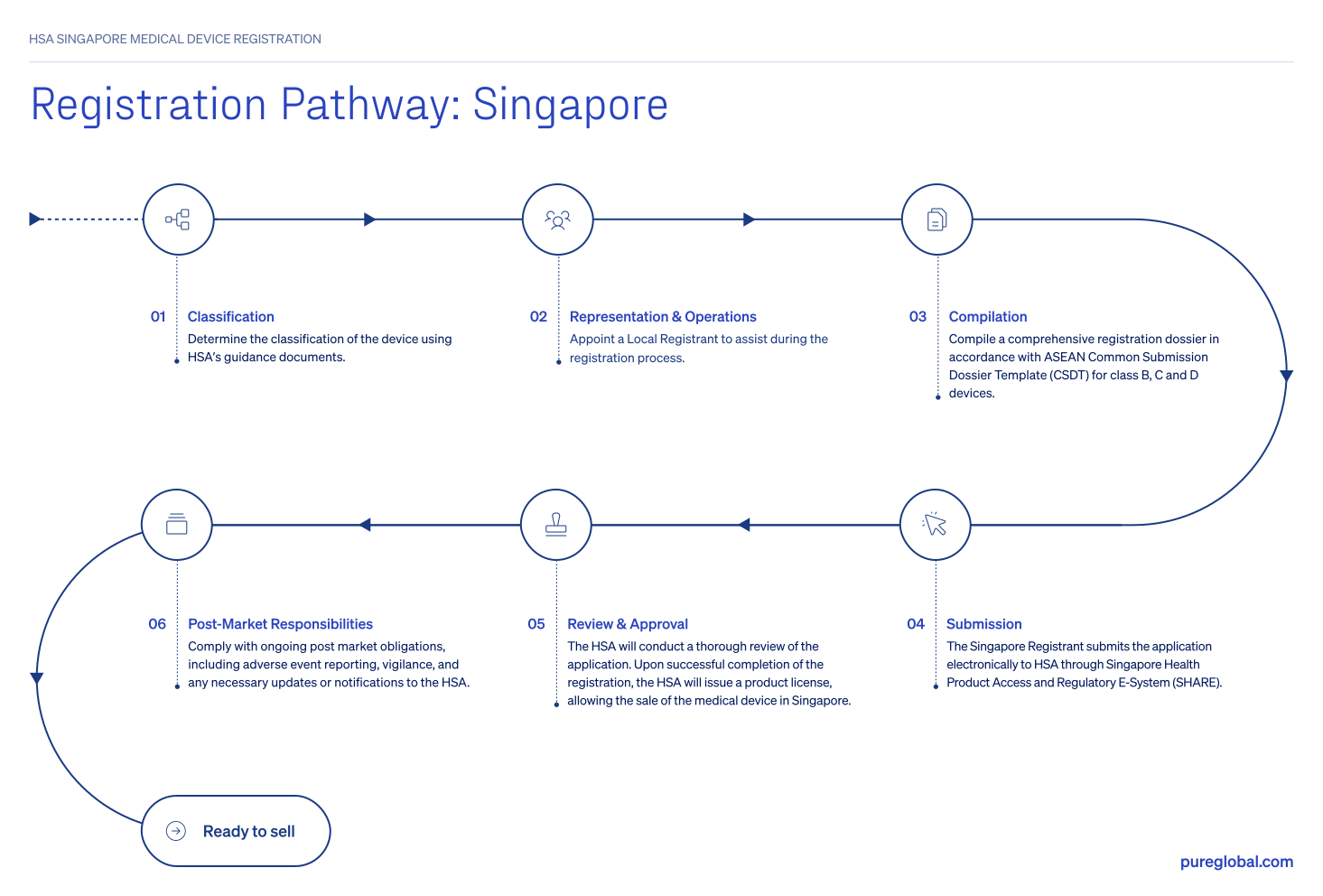
HSA Singapore Medical Device Registration Pathway
How We Can Help

Faster submissions. Predictable costs. Local support.

We provide turnkey regulatory support in Singapore, all for a flat annual fee:

Dossier preparation and submission, powered by AI-assisted workflows and regulatory experts.

In-country representation, with Pure Global serving as your Registrant to the HSA.

Post-market surveillance support, including vigilance reporting and authority communications.

Importer authorizations, post-approval modifications, and renewals.

Frequently
Asked Questions

What Government fees apply to device registration in Singapore?

HSA charges mandatory government fees based on device risk class and evaluation type, with fees assessed per product. Singapore applies a base application fee and, for Class B, C, and D devices, an additional evaluation fee.

An application fee of SGD 560 (approximately USD 435) applies to all classes.

In addition, the following evaluation fees apply:

  • Class B – Abridged Evaluation: SGD 2,010 (approximately USD 1,561) per product
  • Class C – Abridged Evaluation: SGD 3,900 (approximately USD 3,028) per product
  • Class D – Full Evaluation: SGD 6,250 (approximately USD 4,853) per product

All fees listed are government fees only and do not include consulting services, dossier preparation, testing, or regulatory representation. Fees may change without notice.

Check our Fee Calculator for up-to-date government fees in 14 markets.

How does Pure Global’s flat fee pricing work in Singapore?

Pure Global offers flat-fee annual pricing for bundled medical device and IVD registration and representation in Singapore, starting at $2,000/year. The flat fee includes dossier preparation and submission, in-country representation, translation, modifications, distributor authorization, and post-market support. The fee does not include HSA or other government fees, certified translations, or translations from languages other than English.

Flat fee structure for Class A/B devices:

1 device = $2,000/year

2-5 devices = additional $1,000 per device per year (e.g., 4 devices = $5,000/year)

6-10 devices = additional $500 per device per year (e.g., 8 devices = $7,500/year)

Flat fee structure for Class C/D devices:

1 device = $3,000/year

2-5 devices = additional $1,500 per device per year (e.g., 4 devices = $7,500/year)

6-10 devices = additional $1000 per device per year (e.g., 8 devices = $12,000/year)

Contact us for a custom quote if you have 11+ devices.

A three-year contract is required to lock in the fees quoted above. However, other contractual arrangements are available. Use our Fee Calculator for an instant estimate and more information about flat fee terms.

How are medical devices classified in Singapore?

Singapore adopts a risk-based classification system for medical devices, categorizing them into Classes A, B, C, and D. This classification influences the requirements for the Singapore medical device register and the level of regulatory scrutiny applied to each device.

Single Process,
Multiple Markets

When you partner with Pure Global, a single registration process opens doors to multiple countries. Our global subsidiaries make this streamlined path possible.

Let's Talk,
Anywhere You Are.

Whether looking for more information or ready to partner with us, we're here to guide you through every step of the regulatory process.

Contact us