

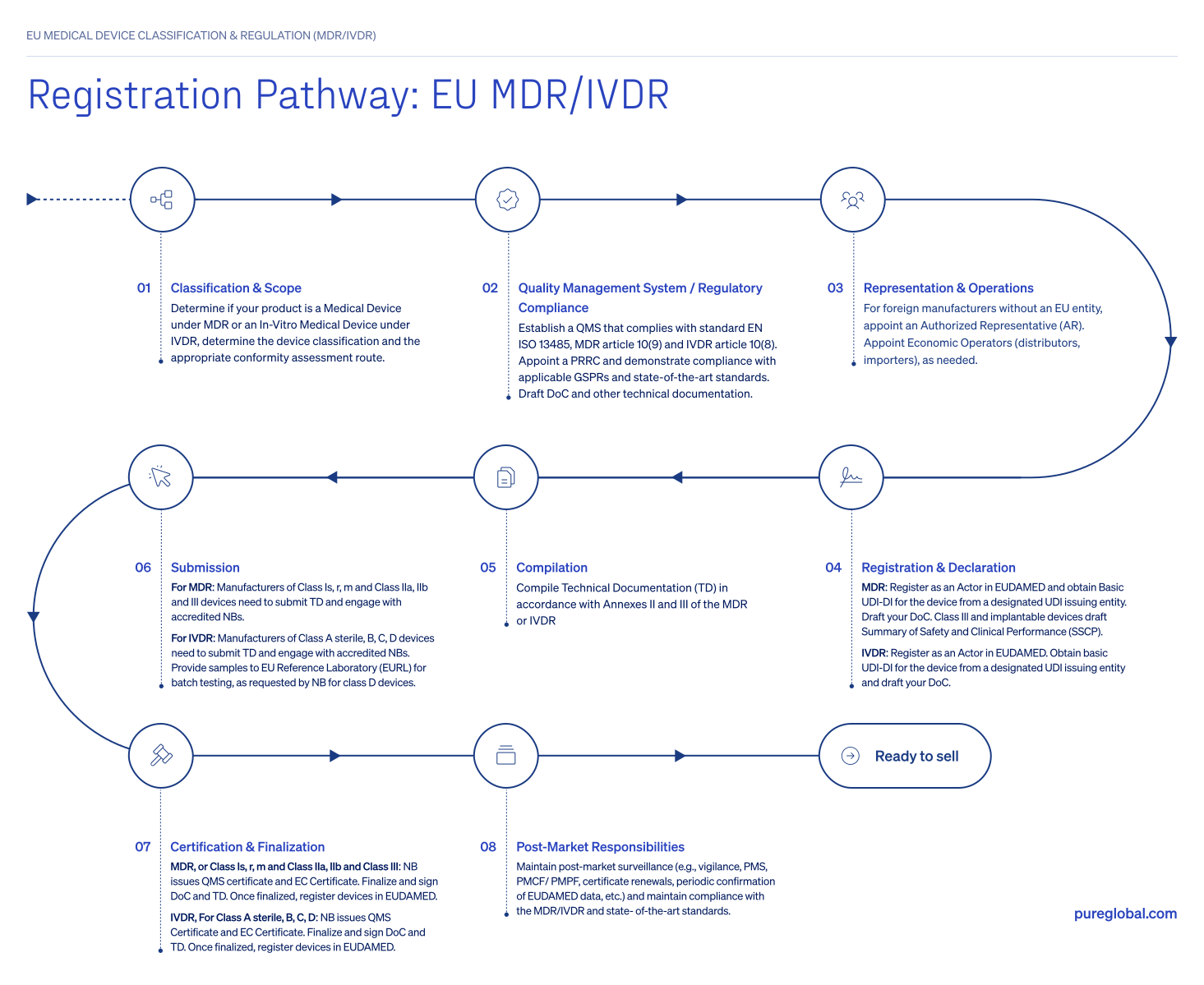
EU medical device and IVD registration requirements are governed by the MDR and IVDR. Low-risk Class I devices follow a self-certification route, but most devices require Notified Body involvement, formal certification, and full technical documentation review to obtain CE Marking.
Pure Global simplifies the process with AI workflows that accelerate Technical Documentation preparation. Local support and representation are available for a flat annual fee.

The European Union, comprising 27 countries with a total population of nearly 450 million, is the second-largest market for medical devices globally. The introduction of the MDR and IVDR marks a significant overhaul of EU medical device classification and regulation, aiming to enhance device safety and performance across the EU.

Medical devices placed on the market in the European Union (EU) are regulated by the European Commission (EC) and competent authorities of EU Member States. The primary legislations are Regulation (EU) 2017/745 on medical devices (EU MDR) and Regulation (EU) 2017/746 on in vitro diagnostic medical devices (EU IVDR), which replaced the earlier Medical Devices Directive (MDD), Active Implantable Medical Devices Directive (AIMDD), and In Vitro Diagnostic Directive (IVDD).
Devices must comply with the applicable EU regulatory requirements and bear the CE mark before being placed on the EU market. Manufacturers must also register their devices and relevant economic operators in the European database for medical devices (EUDAMED).
Manufacturers not based in the EU must appoint a European Authorised Representative (EU AR). The EU AR acts on behalf of the manufacturer ensuring regulatory compliance is upheld for the devices they represent in the European market, including maintaining a copy of the technical documentation, Declarations of Conformity, and acting as a liaison between the Manufacturer and the EU competent authorities.
Medical devices are classified as Class I self-certified, Class I sterile, Class I measuring, Class I reusable, Class IIa, Class IIb, and Class III under the EU MDR. IVDs are classified as Class A self-certified, Class A sterile, Class B, Class C, and Class D under the EU IVDR. Classification determines the conformity assessment route and the level of Notified Body involvement required.
There is one principal route to market for the EU: CE marking under the applicable EU regulation. The specific conformity assessment procedure and route depends on the nature, intended purpose, and applicable classification of the device.
CE Marking under EU MDR (Regulation (EU) 2017/745)
CE Marking under EU IVDR (Regulation (EU) 2017/746)
Key EU registration requirements
Documentation requirements depend on device classification and the selected conformity assessment procedure. In general, manufacturers should prepare:
An EU AR is a legal entity established in an EU Member State that acts on behalf of a manufacturer located outside of the EU. The EU AR ensures that the EU Declaration of Conformity and technical documentation have been drawn up, cooperates with competent authorities and manufacturers on post-market surveillance and vigilance activities, and maintains copies of technical documentation for inspection. Under the EU MDR and EU IVDR, the EU AR is explicitly identified on device labels and is held equally liable as the foreign Manufacturer. Non-EU manufacturers cannot place devices on the EU market without appointing an EU AR.
A Notified Body is an independent conformity assessment organization designated to carry out third-party assessments under the EU MDR or EU IVDR. Notified Bodies review quality management systems, technical documentation, and clinical or performance evidence for higher-risk devices before issuing EU certificates. Only NBs with an appropriate scope of designation can assess certain device types. The list of currently designated EU MDR and EU IVDR Notified Bodies is maintained in the NANDO (New Approach Notified and Designated Organisations) database. Manufacturers may select any Notified Body with the relevant designation, regardless of the EU Member State in which the Notified Body is established.
The EU MDR and EU IVDR introduced transitional provisions to allow time for manufacturers, Notified Bodies, and the supply chain to adapt. These have been extended multiple times by the European Parliament and Council. The current key deadlines are:
EU MDR (Regulation (EU) 2017/745) transitional provisions as identified in Regulation (EU) 2023/607:
Devices must comply with all the requirements identified in Regulation (EU) 2023/607 to benefit from these transitional deadlines. The conditions are:
EU IVDR (Regulation (EU) 2017/746) transitional provisions as identified in Regulation (EU) 2024/1860:
Devices must comply with all the requirements identified in Regulation (EU) 2024/1860 to benefit from transitional deadlines. The conditions are the following:
Devices placed on the EU market after these transitional deadlines, or devices that do not meet all the conditions from Regulation (EU) 2024/1860 or Regulation (EU) 2023/607, must comply fully with the EU MDR or EU IVDR. Manufacturers should monitor EU legislative developments for further changes to deadlines and requirements.
Manufacturers holding a MDD, AIMDD, or IVDD certificate must transition their legacy devices to EU MDR or EU IVDR conformity before the applicable transitional deadline and shall meet the transitional timelines requirements as per Regulation (EU) 2023/607 for Medical Devices or Regulation (EU) 2024/1860 for IVDs. The transition process involves a full conformity assessment under the new regulation, including updated technical documentation, a new clinical evaluation or performance evaluation under the updated requirements, and Notified Body certification where required. Manufacturers should engage their Notified Body early, as capacity is limited and timelines for initial certification under EU MDR and EU IVDR are typically long. EUDAMED registration under the new framework must also be completed as part of the transition. It is important to note that legacy devices will also require EUDAMED device registration by 27 November 2026.
Our expert services simplify your entry into the EU market:

Assistance with product classification and determination of the regulatory pathway.
Support in compiling the necessary technical documentation for compliance with the EU MDR/IVDR.
Acting as your EU Authorized Representative includes EUDAMED support and more for an annual flat fee.

Pure Global offers flat-fee annual pricing for bundled EU Authorized Representative services and regulatory support in the EU, starting at $2,000/year. The flat fee includes document review, EUDAMED support, and Certificate of Free Sale (CFS) processing. Third party fees, when applicable, are not included.
Flat fee structure for medical devices and IVDs:
1 device or device group = $2,000/year
2-5 devices/groups = additional $500 per device per year (e.g., 5 devices = $4,000/year)
6-10 devices/groups = no additional cost (e.g., 8 devices - $4,000/year)
Contact us for a custom quote if you have 11+ devices.
A three-year contract is required to lock in the fees quoted above. However, other contractual arrangements are available. Use our Fee Calculator for an instant estimate and more information about flat fee terms.
The cost of entry to the European market will largely depend on risk classification, the fee for conformity assessment activities carried out by notified bodies (NBs), and whether clinical investigations are necessary. Foreign manufacturers will also need to consider representation fees. For regulatory support and depending on the level of assistance needed, manufacturers can expect anywhere from €4000 to €50,000 or more. This does not include any performance testing and certification costs.
The official timelines for market access will vary greatly between low-risk and high-risk devices. Devices that require NB involvement need to consider review timelines for conformity assessment. Manufacturers can expect anywhere from 6–36 months depending on the quality of the application. This timeline does not consider clinical investigations or additional performance testing.
Appointing an EU Authorised Representative (EUAR) is essential for foreign manufacturers because the EUAR acts as a liaison with European national Competent Authorities. The EU Authorised Representative ensures compliance with EU regulations, facilitates communication, and handles regulatory issues, enabling the manufacturer to market their medical devices in the EU.
When you partner with Pure Global, a single registration process opens doors to multiple countries. Our global subsidiaries make this streamlined path possible.
Whether looking for more information or ready to partner with us, we're here to guide you through every step of the regulatory process.
Contact us

%201.svg)


