

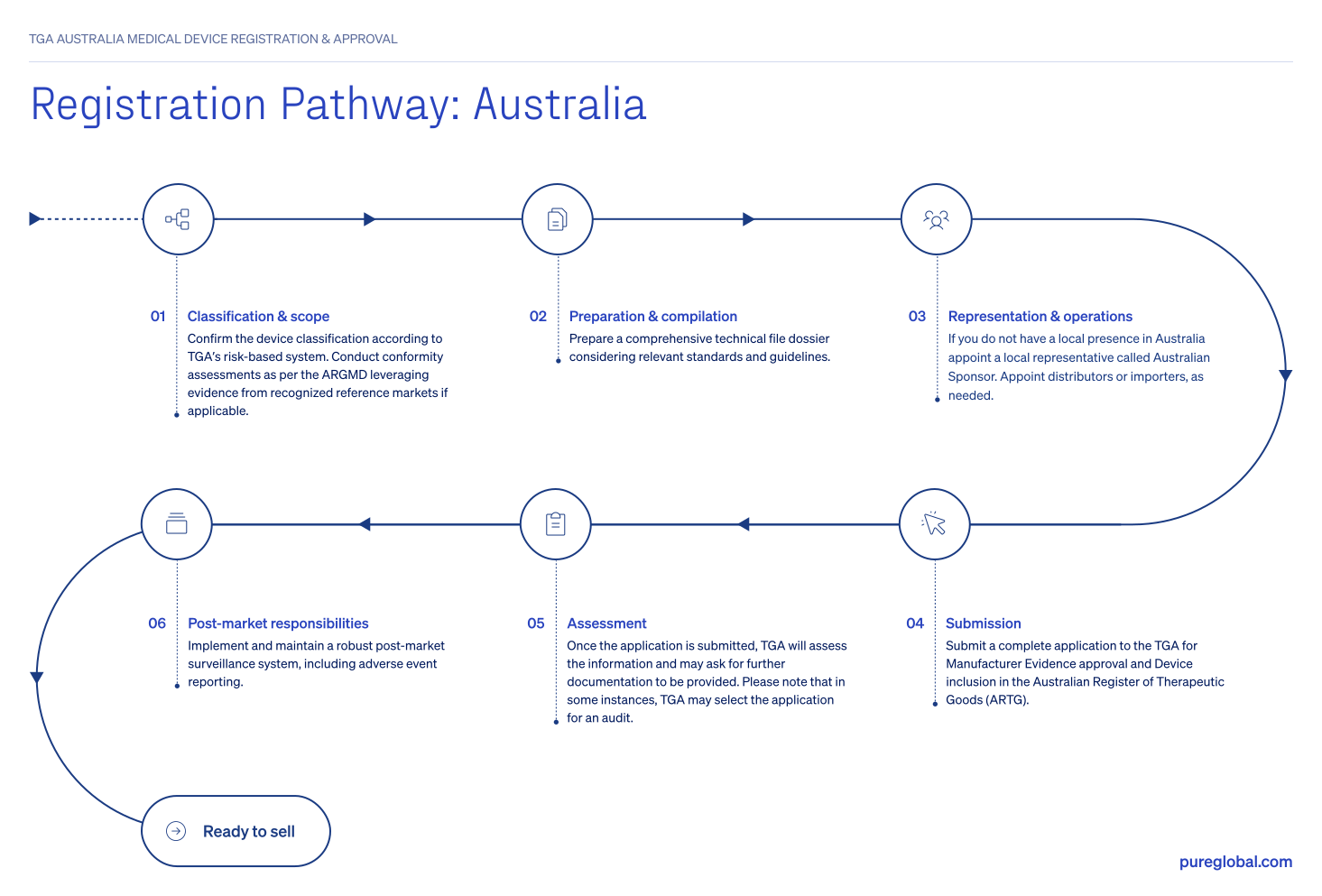
Australia medical device registration requirements include listing in the Australian Register of Therapeutic Goods (ARTG) before they can be legally distributed. The Therapeutic Goods Administration (TGA) regulates this process and requires foreign manufacturers to appoint an Australian Sponsor to submit the application and act as the regulatory liaison.
Pure Global simplifies Australia TGA medical device registration with AI workflows, along with local support and representation, all for flat fees.

Australia, with a population exceeding 25 million, is a significant import market for medical devices and diagnostics, with around 80% of its market needs met through imports mainly from the United States, China, and Germany. The market is particularly receptive to innovative products that expedite patient recovery, reduce healthcare costs, and address chronic pain and disability.

Medical devices and IVDs sold in Australia are regulated by the Therapeutic Goods Administration (TGA) under the Australian Department of Health. The primary medical device regulations are the Therapeutic Goods Act of 1989 and Therapeutic Goods (Medical Devices) Regulations 2002.
Devices must be included in the Australian Register of Therapeutic Goods (ARTG) before they can be marketed. Inclusion requires a conformity assessment, either by the TGA or via prior approval from an accepted reference authority, including EU Notified Bodies (CE), the US (FDA), Japan (PMDA), Canada (Health Canada), Singapore (HSA), and Medical Device Single Audit Program (MDSAP) Auditing Organizations.
Foreign manufacturers must appoint a local representative known as the Australian Sponsor. The Sponsor is the Australia-based legal entity responsible for any foreign therapeutic goods entering the Australian market.
A risk-based classification system is used to determine regulatory requirements for medical devices and IVDs. Medical devices are classified as class I, IIa, IIb, and III; IVDs are classified as Class A, B, C, D.
Australia has two regulatory pathways: Full TGA Conformity Assessment or the Abridged pathway, which requires approval in an accepted reference market. The Abridged route can shorten review timelines but may still be subject to random and mandatory application audits (for higher risk devices).
TGA Conformity Assessment Route (All classes of medical devices and IVDs)
Abridged Route (All classes of medical devices and IVDs)
Key TGA registration requirements
Specific documentation requirements vary depending on your device classification and whether you are pursuing TGA Conformity Assessment or the Abridged pathway. To register a device with the TGA, the following are typically required:
Only then, the ARTG inclusion application may be submitted, and payment of government fees is completed. Without the payment, TGA will not process the ARTG inclusion application.
TGA may request additional documentation during review, especially for higher-risk products or applications selected for audit.
An Australian Sponsor is a legal entity based in Australia that acts as the regulatory representative for foreign medical device manufacturers. The Sponsor is responsible for submitting device applications to the TGA, supporting the manufacturer to maintain compliance, facilitating adverse event reporting, and managing post-market obligations. Without a Sponsor, foreign manufacturers cannot obtain ARTG inclusion.
Manufacturer Evidence (ME) is proof that a medical device manufacturer has an appropriate QMS and has followed the required conformity assessment procedures. QMS documentation submitted as ME can include QMS conformity assessment certificates from EU Notified Bodies, the US, Japan, Canada, Singapore, and Medical Device Single Audit Program (MDSAP) Auditing Organizations. The Australian sponsor submits these documents through the TGA Business Services portal to obtain a Manufacturer Evidence identifier, which must be referenced in ARTG applications. Without the Manufacturer Evidence approval, the ARTG inclusion application may not be submitted.
A TGA application audit is an additional regulatory review conducted after preliminary assessment for inclusion in the ARTG. TGA examines technical, clinical, and regulatory evidence more closely to confirm safety, performance, and compliance. While any application may be audited, the TGA uses a risk-based approach to select device applications for audits.
There are two types of audits: mandatory and non-mandatory. Mandatory audits are required by regulation for certain higher-risk applications, including specific Class III devices supported by EU MDD or US 510(k) approvals, certain system or procedure packs containing higher-risk components, and certain higher-risk IVDs. These audits typically involve detailed review of technical documentation and evidence, carrying an additional fee to be paid to TGA. Non-mandatory (discretionary) audits may be applied to any device based on risk criteria such as device characteristics, regulatory reform priorities, quality of submitted documentation, post-market safety signals, or concerns related to the sponsor or manufacturer. The TGA can expand or waive an audit depending on evidence. No fee currently applies to non-mandatory audits.
Our specialized services in the Australian market include:

Determining the classification and grouping of your products to identify the correct regulatory pathway.
Preparing and compiling the necessary technical dossier for the TGA registration process.
Acting as your TGA Sponsor includes ARTG registration and more for an annual flat fee.

For most devices up to Class IIb, the timeline is typically 4–6 weeks, including dossier compilation. Class III and AIMDs may take around 6 months, though total time varies based on TGA requests and possible audits.
Registration costs typically range from $4,000 to $8,000 USD depending on device classification and whether market reference approvals are used. Additional government fees of $1,000 to $2,000 USD may apply, excluding testing or certification costs.
Pure Global offers flat-fee annual pricing for bundled TGA Sponsor services and regulatory support in Australia, starting at $2,000/year. The flat fee includes document review, ARTG registration, and Certificate of Free Sale (CFS) processing. Government and other third party fees, when applicable, are not included.
Flat fee structure for medical devices and IVDs:
1 device or device group = $2,000/year
2-5 devices/groups = additional $500 per device per year (e.g., 5 devices = $4,000/year)
6-10 devices/groups = no additional cost (e.g., 8 devices - $4,000/year)
Contact us for a custom quote if you have 11+ devices.
A three-year contract is required to lock in the fees quoted above. However, other contractual arrangements are available. Use our Fee Calculator for an instant estimate and more information about flat fee terms.
TGA charges mandatory government fees based on device classification and submission type, with fees assessed per product. There are one-time application fees and recurring annual charges once a product is included on the ARTG.
One-time application fees apply to medical device registrations:
Annual fees apply by risk class:
For in vitro diagnostics (IVDs):
All fees listed are government fees only and do not include consulting services, dossier preparation, conformity assessment activities, testing, or regulatory representation. Fees can change without notice.
Check our Fee Calculator for up-to-date government fees in 14 markets.
An application audit (also called a technical file review) is when TGA conducts a thorough review of your technical documentation. TGA marks certain devices (such as specific IVDs) that automatically require an application audit, though it can select any ARTG application for review. If your device or application requires an application audit, the TGA will notify you and you must pay a fee.
When you partner with Pure Global, a single registration process opens doors to multiple countries. Our global subsidiaries make this streamlined path possible.
Whether looking for more information or ready to partner with us, we're here to guide you through every step of the regulatory process.
Contact us
%201.svg)


